

Industry research
Rigid Packaging
Scope
Europe
Companies
132
Key takeaways
What is the scope of this industry report?
The rigid packaging market comprises businesses involved in the production of solid packaging products made out of plastic, metal and glass for a wide range of end markets. We segmented the European landscape by material and product type into: (i) plastics, (ii) metal, (iii) glass, (iv) multi-material and (v) caps, closures & lids.
What does the Rigid Packaging landscape look like in Europe?
The location of production facilities plays a significant role in the viability of packaging businesses. Due to the bulky product nature of rigid packaging, excessive logistics costs may quickly erode players’ profit margins. Geographic expansion comes with significant CAPEX in the acquisition or construction of new production facilities. Cash-rich players have a natural advantage as they can grow inorganically at a faster pace than smaller players with relatively fewer resources. That is exactly why smaller incumbents instead aim to develop an innovative edge to bypass this growth-driven competition. Furthermore, the increasingly stringent EU regulations on packaging waste and consumer demand for more sustainable packaging drive players to modify their production lines and to source more expensive sustainable materials from suppliers. In turn, this puts smaller players with less financial resources at a disadvantage. Despite the highly acquisitive strategies of large incumbents, the European landscape still has a rather fragmented nature, as international expansion remains difficult with comparable larger peers already levering an entrenched (local) presence.
What is the level of investor activity in the European Rigid Packaging industry?
Investor-led activity in the European rigid packaging market has been moderate, with ~30% of identified players being investor-backed (March 2025). Stable product demand from multiple resilient end markets, a fragmented competitive landscape with ample buy-and-build potential and opportunities to develop new sustainable products are considered the most attractive factors for financial sponsors. On the other hand, the potential increase in tariffs on imported raw materials from China, the reduction in overall packaging volume ordered and the need to operate manufacturing plants locally at costly European locations act as deterrents for investors.
What are the key ESG considerations in the European Rigid Packaging industry?
The packaging industry faces a high degree of public scrutiny from government bodies and consumers, mainly due to the packaging waste generated. Moreover, greenhouse gas emissions (GHG) and energy efficiency also represent important environmental risks in this market. Accordingly, players attempt to mitigate these issues by increasing the share of recyclable packaging in their offerings. Incumbents also attempt to improve their energy efficiency by sourcing it from renewable sources. In terms of social risks, personnel safety and product safety are top of mind. Incumbents conduct recurring audits and assessments on their suppliers to ensure safe working conditions. However, the main issue in this topic is the release of microplastics into the environment, creating a risk for human health. Players develop new packaging materials such as bio-based plastics to limit this issue.
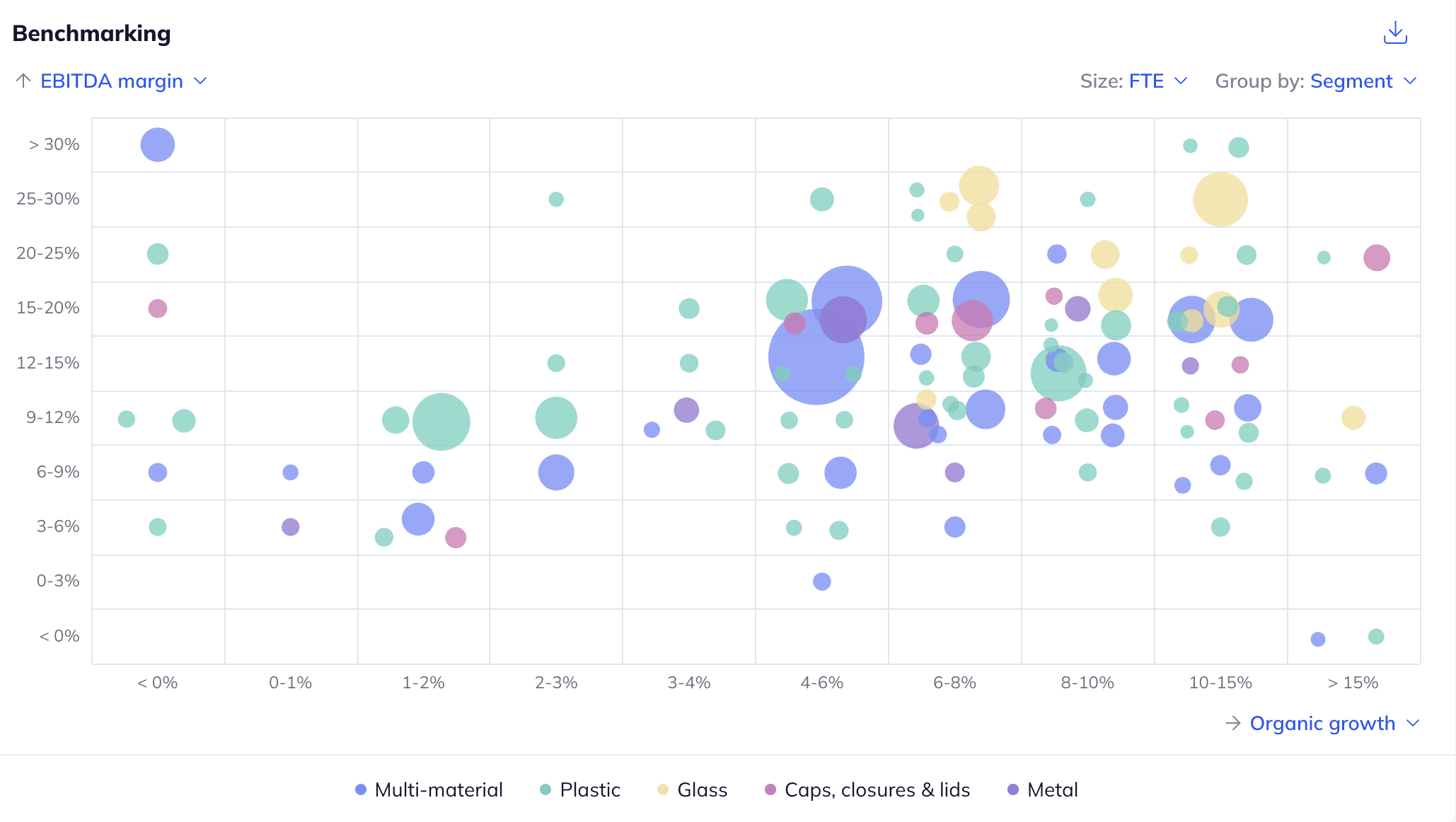
Company benchmarking
Market growth
According to Technavio (December 2024), the global self-storage and moving services market is projected to reach ~$161.2bn in 2029, up from ~$103.8bn in 2024 (+9.3% CAGR 2024-2029)
The area of European self-storage facilities grew from ~9.8m sqm in 2019 to ~16.5m sqm in 2024 (+67%; CBRE, October 2024)
Positive drivers
Rising urbanisation and shrinking living spaces across Europe drive demand for self-storage services. As more people continue moving to metropolitan areas with limited housing space, the need for secure, flexible storage options increases, presenting significant growth opportunities for the storage market (EUBusiness News, January 2025; London Datastore, January 2025)
The factory relocations and business restructuring across Europe drive demand for specialised industrial moving services. As companies seek to optimise operations and adapt to evolving market conditions, professional relocation providers benefit from increased project volumes and complex logistical requirements (Suret, July 2024)
Technological advancements, including AI, robotics, big data analytics and IoT, transform the logistics and moving services industry by enhancing operational efficiency, improving customer satisfaction, reducing costs and optimising the logistics and relocation process (DHL, December 2023)
Negative drivers
Rising rental costs and low housing mobility across Europe create challenges for the moving services market. With tenants hesitant to relocate due to favourable existing contracts and housing shortages in key urban areas, demand for relocation services may be constrained (Relocate Global, December 2024)
The shortage of available space for self-storage units across Europe caps growth opportunities in the market. The locations for new developments are increasingly difficult to find and the competition for existing units drives up the rental costs, hindering expansion in key metropolitan areas (ISS, November 2024)
Rising fuel prices, labour shortages and tightening environmental regulations increase operational costs in the moving services market. These are passed on via service fees, which may deter budget-sensitive clients, while labour scarcity and compliance costs further constrain profitability (Searates, December 2023; ING December 2023)
Fill out the form to request your copy of the Rigid Packaging industry report
With the full report, you’ll gain access to:
Detailed assessments of the market outlook
Insights from c-suite industry executives
A clear overview of all active investors in the industry
An in-depth look into 132 private companies, incl. financials, ownership details and more.
A view on all 387 deals in the industry
ESG assessments with highlighted ESG outperformers
Discover hundreds of niche industry reports on Gain
Deep dive into additional industries to understand their market outlook, positive and negative drivers, and more!