

Industry research
Pharma CRO industry
Scope
Europe
Companies
94
Key takeaways
What is the scope of this industry report?
The European pharmaceutical contract research organisation (CRO) market comprises businesses that provide outsourced drug discovery, preclinical research and clinical trial management and execution services to pharmaceutical and BioTech companies. We segmented the European pharmaceutical CRO market based on the research stages into: (i) drug discovery & preclinical and (ii) clinical.
What does the Pharma CRO landscape look like in Europe?
Consolidation has progressed across both the discovery & preclinical and clinical CRO segments in Europe, although the dynamics differ across the segments. In Europe’s discovery and preclinical CRO segment, deals are more often capability-led bolt-ons that add specialist scientific, regulatory or modality expertise. In contrast, consolidation in the clinical segment is centred around the development of scaled, technology-enabled end-to-end platforms. As pharmaceutical companies streamline vendor lists and digital transformation raises the need for integrated delivery, mid-tier CROs get increasingly squeezed out. In addition, two structural shifts are reshaping the market. First, AI is increasingly used to accelerate drug discovery and preclinical research while reducing costs. At the same time, clinical outsourcing is shifting from traditional full-service contracts (FSO) toward more modular functional service provision (FSP) models tailored to specific needs, alongside growing adoption of hybrid decentralised trial execution driven by demand for greater patient convenience and more efficient monitoring.
What does the Pharma CRO market landscape look like in Europe?
Sponsor-led interest has been significant, with ~65% of identified assets backed by financial sponsors (March 2026). Investors are primarily attracted by (i) sustained CRO outsourcing demand, (ii) tech-enabled efficiency gains (e.g. AI, digital tools supporting decentralised trials) and (iii) nearshoring tailwinds for Europe-based CRO services. On the other hand, (i) persistent shortages of clinical trial professional talent, (ii) patent-cliff-driven budget constraints from major pharmaceutical clients and (iii) intensifying competition from the US and cost-effective regions (e.g. Asia) serve as key deterrents for investors.
What are the key ESG considerations in Europe's Pharma CRO industry?
Relevant ESG topics mainly relate to social and environmental challenges. Socially, CROs accelerate drug development and provide flexible access to expertise, while carrying major responsibilities for patient safety and the protection of sensitive data. Inclusive trial participation remains a key issue, as underrepresentation of certain groups creates a gap between trial populations and the real-world disease burden, potentially undermining confidence in consistent therapy performance across patients. Identified players address the issue through AI-led targeting plus community and social outreach to improve enrolment of underrepresented patient groups. From an environmental perspective, trial emissions primarily relate to logistics and travel as part of CRO processes. Incumbents aim to cut footprint through decentralised and digital trial approaches, more local sourcing and more standardised and reusable materials.
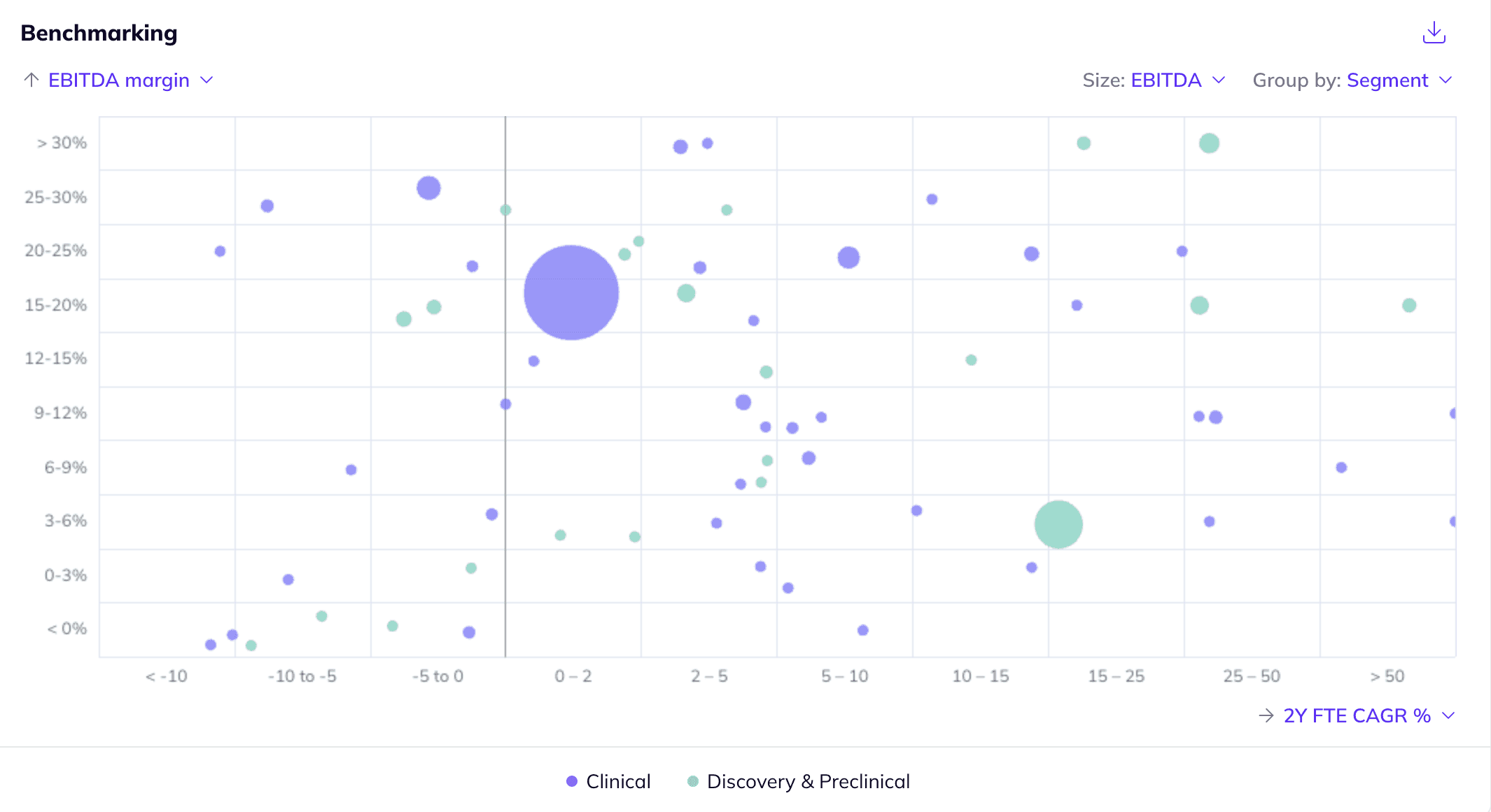
Company benchmarking
Market growth
Statista (February 2026) projects that the global CRO market will grow from ~$56.5bn in 2022 to ~$108.0bn in 2032 (~6.7% CAGR)
The global preclinical CRO market was valued at ~$5.7bn in 2024 and is expected to reach ~$8.5bn by 2029 (+8.1% CAGR 2024-2029; Technavio, January 2025)
Positive drivers
The persistent outsourcing trend of pharmaceutical development and research will drive demand for CRO services. Mid-sized pharmaceutical companies handle ~65-70% of activities through CROs, whereas emerging BioTech firms handle ~90% through CROs due to rising R&D costs and complex clinical trials. This sustained demand is further driven by the need for specialised expertise to support innovation in complex therapeutic areas (e.g. oncology; Contract Pharma, June 2025; McKinsey & Company, January 2025; BigPharmaTrend, August 2023)
AI accelerates preclinical development by cutting timelines and costs, while digital tools (e.g. cloud-based platforms, wearable technologies) facilitate the shift toward decentralised clinical trials. This boosts pharmaceutical CROs’ capabilities to operate more efficiently and reduce development timelines (European Medicines Agency, March 2026; European Commission, October 2025; 2 Minute Medicine, September 2025)
Pharmaceutical clients are increasingly nearshoring R&D and clinical trials to enhance IP protection and quality oversight, while US BioTechs move early trials to Europe amid FDA budget cuts and political uncertainty. As a result, Central and Eastern Europe (CEE) is emerging as a key clinical development hub, with ~42 of the ~50 FDA-approved drugs in 2024 included CEE clinical activity, driving rising demand for Europe-based CROs (interview by Gain; Clinical Trials Arena, October 2025; Reuters, May 2025; Pharma Technology Focus, April 2025)
Negative drivers
The continued shortage of experienced clinical research associates (CRAs) is a key impediment to the European pharmaceutical CRO market, intensifying competition for talent and raising recruitment and retention costs. To stabilise delivery, CROs are pushed to increase compensation and refresh benefit strategies to curb turnover, thereby compressing bottom-line margins (BDO, February 2025; Clinical Trials Arena, February 2024)
The impending patent cliff through 2032, as major European pharmaceutical businesses’ blockbuster licences reach expiration, will erode client revenues and may lead to cuts in R&D and outsourcing budgets. At the same time, the need to quickly bring new therapeutics to market necessitates rapid, high-quality CRO services, putting additional operational pressure on timelines and performance (Alcimed, October 2025; Contract Pharma, June 2024)
Sustained competitive pressure from cost-efficient regions (e.g. Asia), supported by more favourable regulations and funding, as well as from the US, where faster patient recruitment accelerates development timelines. In addition, declining trial starts across high-value areas (e.g. oncology, rare diseases) signal a broad demand headwind that may limit long-term growth (IQVIA, October 2024)
Fill out the form to request your copy of the Pharma CRO industry industry report
With the full report, you’ll gain access to:
Detailed assessments of the market outlook
Insights from c-suite industry executives
A clear overview of all active investors in the industry
An in-depth look into 94 private companies, incl. financials, ownership details and more.
A view on all 297 deals in the industry
ESG assessments with highlighted ESG outperformers
Discover hundreds of niche industry reports on Gain
Deep dive into additional industries to understand their market outlook, positive and negative drivers, and more!