

Industry research
Management Consulting
Scope
Europe
Companies
91
Table of contents
Report collaborator:

Isabella Calderon Hoyos (Partner Transaction Advisory & Strategy) from OMMAX provided expert insights for this report. Read the full interview here
Key takeaways
What is the scope of this industry report?
The European management consulting market comprises businesses offering consulting and advisory services across various industries and functions (e.g. logistics, procurement, digital transformation, AI). As such, we segmented the industry according to players' areas of expertise into: (i) generalists and (ii) functional.
What does the Management consulting landscape look like in Europe?
The European landscape remains highly fragmented but shows a consolidated picture at the top, with dominant European incumbents (e.g. BearingPoint, Roland Berger) mainly facing competition from US-based peers (e.g. Boston Consulting Group, McKinsey & Company). These large players are followed by a long tail of small- and medium-sized (niche) players. While strategic M&A has been prevalent in recent years, barriers to entry are virtually non-existent, as the main resource for starting a new management consulting business is human capital. In this context, smaller players are able to remain competitive through sector-focused specialisations and more execution flexibility.
What is the level of investor activity in Europe's Management consulting industry?
Sponsor-led interest has been moderate, with ~48% of identified assets backed by financial sponsors (as of February 2026). This interest is mainly driven by (i) ongoing global political uncertainties leading companies to seek strategic advice, (ii) increasing regulation prompting compliance consulting services and (iii) demand for tech and data enablement across European SMEs. On the other hand, (i) growing in-house consulting practices and AI-led knowledge democratisation, (ii) global competition for highly-skilled talent and (iii) reputational risks represent headwinds for investors.
What are the key ESG considerations in the US's shared mobility industry?
ESG topics primarily revolve around environmental and social challenges. Environmental issues mostly relate to frequent business travel and other Scope 3 emissions across the value chain. Management consulting providers aim to address these by setting net-zero goals and reducing CO₂ footprints across various workflows. On the social front, industry incumbents face the consequences of controversial mandates, which can have a significant impact on large groups of people (e.g. the Gaza Humanitarian Foundation project). To limit social impacts, consulting players set up and adhere to strict business ethics codes.
Company benchmarking
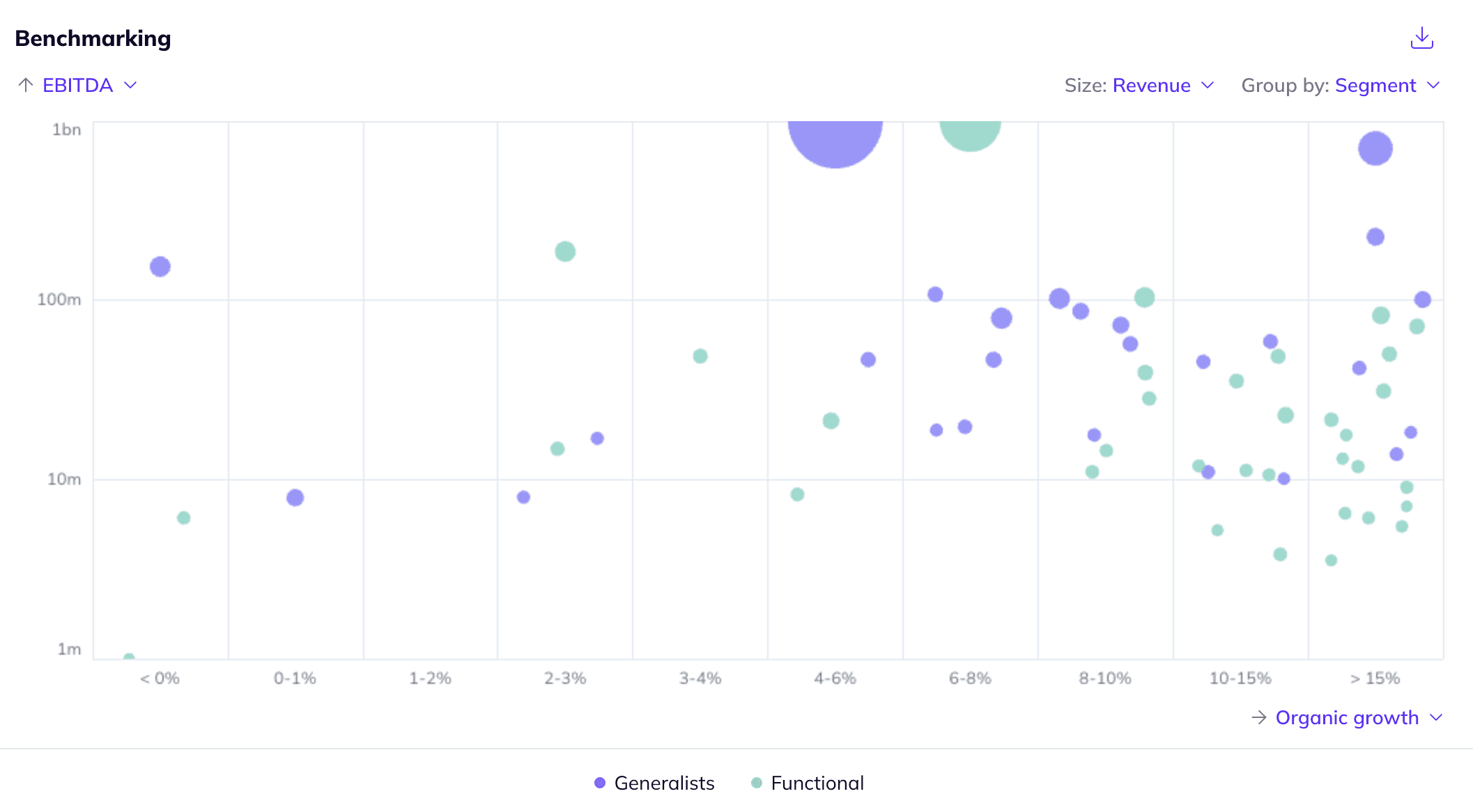
Market growth
The size of the global management consulting industry was estimated at ~$1tn in 2024, growing at a +3.5% CAGR in 2019-2024 (Statista, June 2024)
When looking at service lines, technology (~28%), strategy (~21%) and operations (~20%) consulting services accounted for the majority of European management consulting sales in 2024 (FEACO, January 2026)
Positive drivers
Rising uncertainties related to supply chain, inflation and geopolitical issues (e.g. Russian invasion of Ukraine, trade tariffs) create opportunities for consulting players, with clients increasingly seeking external expertise to navigate an increasingly complex work environment (interview by Gain; OMMAX expert interview)
Expanding regulatory hurdles (e.g. cybersecurity, sustainability, AI, data) force companies to achieve efficient compliance. This creates room for consulting players to provide them with strategic guidance and implementation services to adapt to new regulations (UNITY, February 2026; OMMAX expert interview)
Tech & data enablement trends for basic digital adoption will continue to drive demand from SMEs for non-manufacturing operations as they aim to remain competitive. This demand may be supplemented by further growth from up- and cross-sell opportunities (interview by Gain; OMMAX expert interview)
Negative drivers
The expansion of in-house consulting teams reduces corporate reliance on third-party consultants. On top of this, AI-driven knowledge democratisation allows traditional clients to build their own strategic frameworks, thereby eroding the traditional information advantages of established consulting firms and raising expectations on their value-creation offerings (Consulting Quest, February 2025; InnoLead, January 2025; MIT Sloan, October 2023)
Fierce competition for talent, high employee turnover and changing work-life balance preferences among younger generations are leading to rising labour challenges, which can translate into increased acquisition costs and hampered growth (OMMAX expert interview; Deloitte, March 2025)
Growing exposure to social media platforms and digital news may lead to severe reputational damage in cases of poor project execution (e.g. by running projects solely on AI without human checks; OMMAX expert interview) or controversial project participation (Financial Times, August 2025). Ultimately, this threatens long-term industry demand, as potential customers begin to reconsider the trade-offs of hiring consulting experts
Fill out the form to request your copy of the Management Consulting industry report
With the full report, you’ll gain access to:
Detailed assessments of the market outlook
Insights from c-suite industry executives
A clear overview of all active investors in the industry
An in-depth look into 91 private companies, incl. financials, ownership details and more.
A view on all 833 deals in the industry
ESG assessments with highlighted ESG outperformers
Discover hundreds of niche industry reports on Gain
Deep dive into additional industries to understand their market outlook, positive and negative drivers, and more!