

Industry research
Dental chains
Scope
Europe
Companies
72
Key takeaways
What is the scope of this industry report?
The European dental care landscape comprises businesses and public organisations that provide various oral care treatments. Such treatments include preventive, remedial, restorative, emergency and cosmetic procedures. This research focuses on European businesses that operate multiple dental clinics under one or multiple brands. We segmented the market by geographic scope into: (i) international and (ii) domestic.
What does the Dental chains market landscape look like in Europe?
The European dental care market is highly fragmented, with standalone clinics still representing the majority in each regional market. However, the penetration of dental chains varies per country, with the UK demonstrating the highest level at ~35% of clinics operated by chains. Overall, the industry remains poised for consolidation given the abundance of attractive acquisition targets, the cost barriers for new dentists to open their own practices and regulations becoming more supportive of external capital in the industry.
What is the level of investor activity in the European Restaurant chains industry?
Sponsor-led interest has been significant, with ~71% of identified assets backed by financial sponsors (May 2025). Investors are attracted to the resilient underlying demand for dental care and vast opportunities for value creation through buy-and-build. At the same time, the regional fragmentation of the market, the shortages of qualified dentists, represent the main deterrents for investors.
What are the key ESG considerations in the European Restaurant chains industry?
ESG topics relate to environmental, social and governance issues. In terms of the environment, dental clinics rely heavily on single-use plastics, stemming mostly from consumables. Incumbents tackle this by increasing the share of multi-use consumables and products from recycled materials. From a social perspective, unmet dental needs are the key challenge. These are mostly driven by a dentist shortage, leading to growing care costs and long waiting periods. To improve this, players offer free dental care services for children and open new clinics in underserved areas, while governments target their funding towards dental education and ease the registration of foreign dentists. Finally, in terms of governance, the distance between chains’ executives and their standalone clinics has led to managerial misconduct which turned into bankruptcies (e.g. France) and disrupted delivery of dental care.
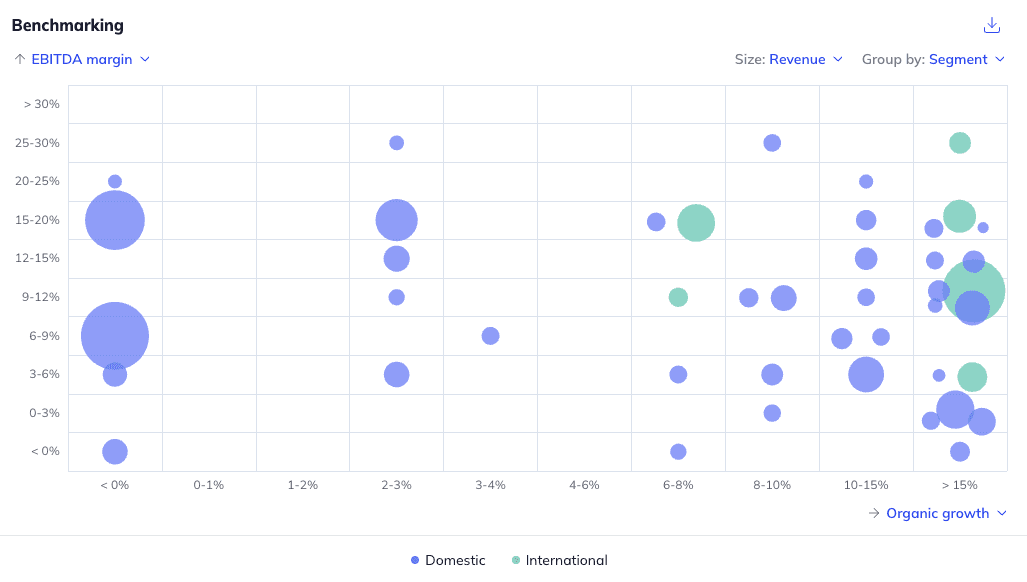
Company benchmarking
Market growth
The global dental service market was estimated at ~$475.8bn in 2024 and is projected to reach ~$769.8bn by 2034 (~5% CAGR). The European market accounted for 30% of the global market in 2024 ($142.7bn; Towards Healthcare, May 2025)
Dental care accounted for 5% of the EU’s public healthcare expenditure (€82.4bn) and ~14% of the EU out-of-pocket healthcare spending in 2022 (OECD, November 2024)
Positive drivers
Favourable demographic trends, with citizens aged over 65 set to account for ~32.5% of the EU population by 2100, up from 21.1% in 2022 (Eurostat, March 2023). From a dentistry perspective, these patients require more frequent remedial and restorative care procedures, which generate better margins than preventive treatments (interview by Gain.pro)
Social media proliferation leads to higher body dissatisfaction rates among adults and youth, supporting demand for high-margin cosmetic dentistry procedures (interviews by Gain.pro)
Dental care digitalisation will allow clinics to improve margins and revenue visibility. Specifically, the adoption of CAD/CAM technology, 3D printing and AI-driven diagnostics enables dental chains to improve care efficiency and profitability (BSR, May 2025)
Negative drivers
Growing operational costs driven by the shortage of dentists. This is combined with patients postponing dental care due to higher prices and limited public healthcare coverage (Dental Tribune, January 2025; The Guardian, February 2025; OECD, November 2024)
Headwinds from changing consumer behaviour, with European sugar consumption and smoking rates demonstrating gradual declines (Statista, January 2025; OECD, November 2024). In turn, the new cohort of senior citizens is expected to have better dental health with lower demand for remedial and restorative treatments (interview by Gain.pro)
The growing popularity of at-home oral care products and devices (e.g. teeth whitening liquids, teeth aligners) limits the total addressable market for traditional clinics. Due to lower costs, higher convenience and patients' negative perceptions of dental clinics, conventional dental treatments are being substituted by at-home alternatives (MDPI, March 2025; Cleveland Clinic, March 2022)
Fill out the form to request your copy of the Dental chains industry report
With the full report, you’ll gain access to:
Detailed assessments of the market outlook
Insights from c-suite industry executives
A clear overview of all active investors in the industry
An in-depth look into 72 private companies, incl. financials, ownership details and more.
A view on all 458 deals in the industry
ESG assessments with highlighted ESG outperformers
Discover hundreds of niche industry reports on Gain
Deep dive into additional industries to understand their market outlook, positive and negative drivers, and more!